Effects & effect categories – Yamaha DTX-Multi12 Multi-Pad Electronic Percussion Instrument User Manual
Page 37
TRIGGER
Ref
erence
KIT
MIDI
V
OICE
UTILITY
W
A
VE
PA
TTERN
Internal Design
Owner’s Manual
37
■
Effects & Effect Categories
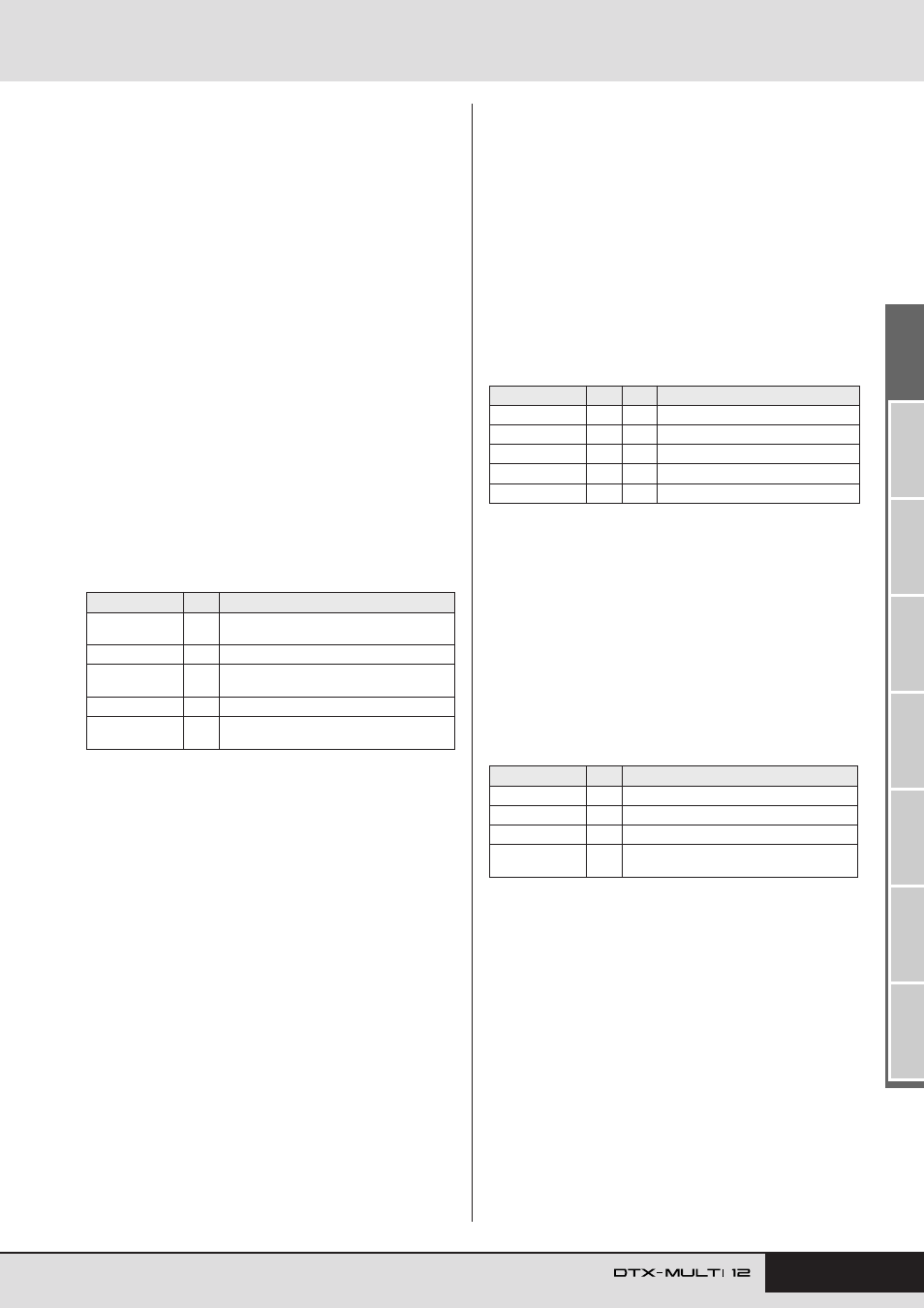
The various individual effects provided by this instrument’s
effect units are sorted into a number of different categories.
What follows is a description of each category and the
effects it contains. We recommend that you refer to these
descriptions whenever setting effects. Each category’s
effect table indicates which of the effect units – i.e., Reverb
(Rev), Chorus (Cho), or Variation (Var) – can be used to
apply the effect in question. Any effect marked using a
✓
symbol can be selected and modified on the corresponding
effect unit’s parameter setting pages.
●
Compressor & EQ
The compressor is an effect commonly used to limit and
compress the dynamics (i.e., softness or loudness) of an
audio signal. In the case of vocals, guitar parts, and other
signals that have widely varying dynamics, this effect
essentially squeezes the dynamic range, making soft
sounds louder and loud sounds softer. Furthermore, a com-
pressor’s attack and decay characteristics can be adjusted
to modify how punchy or sustained an audio signal sounds.
Multi-band compression, meanwhile, splits the input into
three different frequency bands for processing indepen-
dently of each other; accordingly, this type of effect can be
thought of as combining compression with equalization.
●
Flanger & Phaser
A flanger creates a swirling, metallic sound, similar to that
of a jet plane. While this effect operates using the same
basic principles as chorus effects, it uses shorter delay
times and also incorporates feedback to produce a very dis-
tinctive swelling sound. Rather than being used constantly
throughout a song, it is more suited to selective use in spe-
cific sections in order to add variety. A phaser, meanwhile,
introduces a phase shift into the sound being processed
before returning it to the effect input using a feedback cir-
cuit in order to produce a characteristic animated yet mel-
low tone. Gentler overall than a flanger, this effect can be
put to use in a wider range of situations, and for example, is
often used with electric pianos to sweeten their sound in a
variety of ways.
●
Distortion
As its name suggests, a distortion effect distorts the sound
fed into it. It produces a sound similar to that of an ampli-
fier turned up too high or fed with a signal that is already
sufficiently loud. This type of effect is widely used to add a
harsh, biting edge; furthermore, the resultant sound is char-
acterized by overall thickness and long sustain times. This
thickness comes from the large numbers of harmonics con-
tained within clipped signals. Meanwhile, the longer sus-
tain is not produced by the original sound being stretched;
rather, it is produced when the slowly-fading release por-
tion that cannot normally heard is amplified and distorted.
Effect Type
Var
Description
Compressor
✓
Relatively fast-acting compressor well
suited to solo performances.
MltBndComp
✓
Three-band compressor.
3 Band EQ
✓
Three-band compressor also featuring
equalization.
Vintage EQ
✓
Vintage five-band parametric equalizer.
Enhancer
✓
Adds higher-order harmonics to enhance a
sound’s presence.
Effect Type
Cho
Var
Description
SPX Flanger
✓
✓
Produces a swirling, metallic sound.
TempoFlanger
✓
✓
Tempo-synchronized flanger.
PhaserMono
–
✓
Vintage sounding mono phaser.
PhaserStereo
–
✓
Vintage sounding stereo phaser.
TempoPhaser
–
✓
Tempo-synchronized phaser.
Effect Type
Var
Description
AmpSim 1
✓
Guitar amp simulation.
AmpSim 2
✓
Guitar amp simulation.
CompDist
✓
Combines compression and distortion.
CompDistDly
✓
Combines compression, distortion, and
delay.