Lfib, Control plane and forwarding plane – H3C Technologies H3C S10500 Series Switches User Manual
Page 59
48
•
Exp—Three bits in length. Reserved field, usually used for CoS.
•
S—One bit in length. MPLS supports multiple levels of labels. This field indicates whether a label is
at the bottom of the label stack. A value of 1 indicates that the label is at the bottom of the label
stack.
•
TTL—Eight bits in length. Like the homonymous IP header field, it is used to prevent loops.
LSR
A label switching router (LSR) is a fundamental component on an MPLS network. LSRs support label
distribution and label swapping.
LER
A label edge router (LER) resides at the edge of an MPLS network and is connected with another network.
LSP
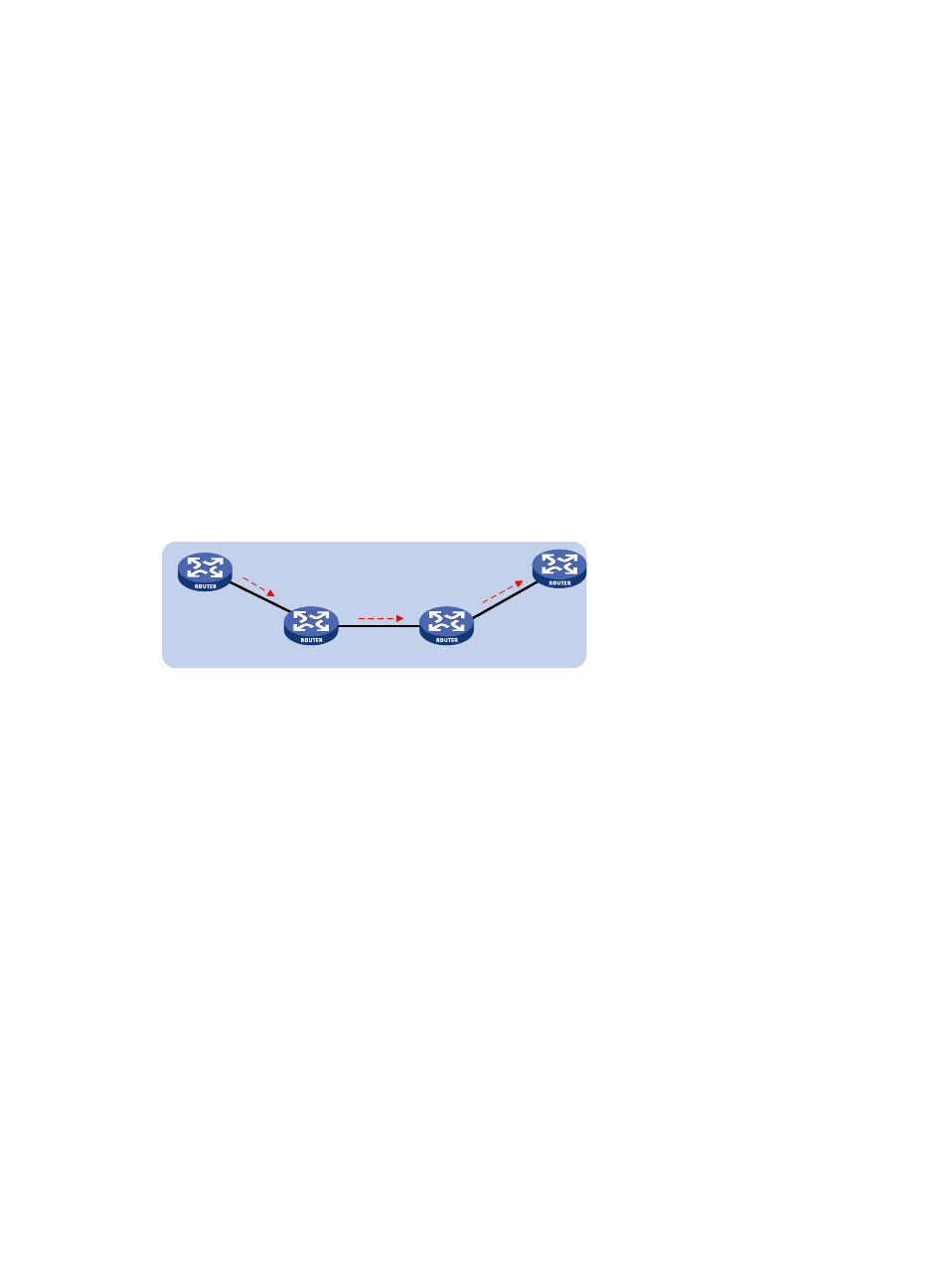
A label switched path (LSP) is the path along which packets of a FEC travel through an MPLS network.
An LSP is a unidirectional path from the ingress of an MPLS network to the egress. On an LSP, two
neighboring LSRs are called the “upstream LSR” and “downstream LSR,” respectively. In
, LSR B
is the downstream LSR of LSR A; LSR A is the upstream LSR of LSR B.
Figure 13 Diagram of an LSP
LSR A
LSR B
LSR C
LSR D
LS
P
LSP
LS
P
LFIB
Labeled packets are forwarded according to the Label Forwarding Information Base (LFIB).
Control plane and forwarding plane
An MPLS node consists of two planes, control plane and forwarding plane.
•
The control plane assigns labels, selects routes, creates the LFIB, and establishes and removes LSPs.
•
The forwarding plane forwards packets according to the LFIB.