Terms and definitions – Junger Audio d07 - Digital Transmission Processor User Manual
Page 64
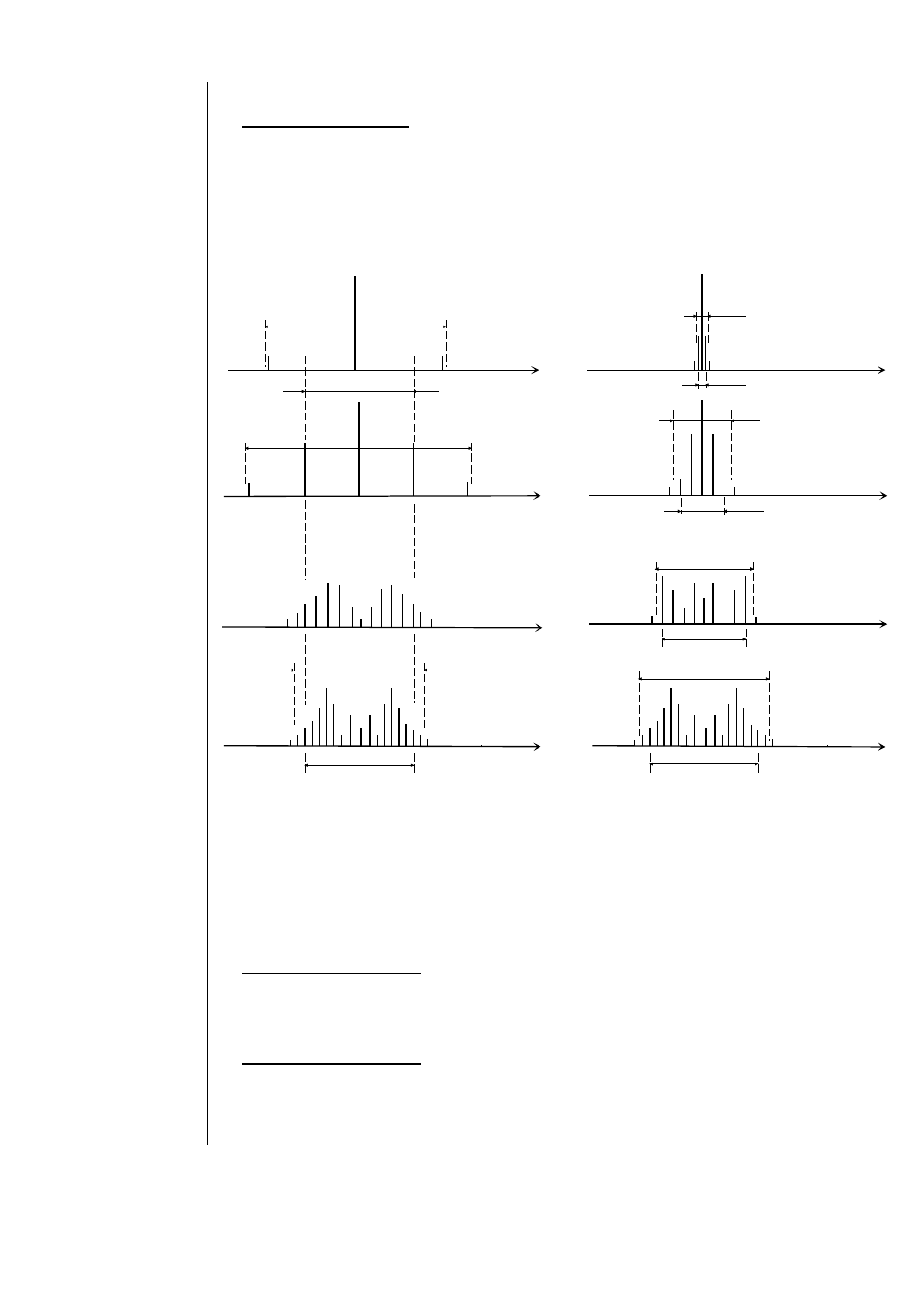
Frequency modulation
The sketch below shows the principal influence of the modulation index m=
∆
fc / fm to
the spectrum of an FM signal. On the left side the frequency deviation
∆
fc (amplitude
of the modulating signal) is constant but the modulating frequency fm changes. On the
right hand the modulating frequency fm is constant but the frequency deviation
∆
fc is
changing :
You can show that a bandwidth of approx B ~ 2 * (
∆
fc(max) + fm(max)) is needed for
FM modulation for high rejection of high frequency signals. With a maximum
frequency deviation of 75kHz and 15kHz cut-off-frequency of the modulating signal B
will be ~ 180kHz. Based on this fact the planning of transmitter positions and power
takes place for area-wide feed. To prevent disturbance in adjacent channels the
maintaining of the frequency deviation needs the highest attention.
Frequency deviation
∆∆∆∆
fc
Value of deviation of the mean frequency from the transmitting frequency of a FM
transmitter caused by the amplitude of the modulating signal.
Peak Deviation
∆∆∆∆
fc(max)
Maximum frequency deviation allowed for an FM transmitter. Defined by the ITU to
+ 75kHz
f
f
m = 0,5
∆
f
c
= 1kHz
f
m
= 2kHz
m = 0,5
∆
f
c
= 0,05kHz
f
m
= 0,1kHz
f
f
m = 1,0
∆
f
c
= 1kHz
f
m
= 1kHz
m = 1,0
∆
f
c
= 0,1kHz
f
m
= 0,1kHz
f
m = 5,0
∆
f
c
= 1kHz
f
m
= 0,5kHz
m = 5,0
∆
f
c
= 0,5kHz
f
m
= 0,1kHz
f
m = 10,0
∆
f
c
= 1kHz
f
m
= 0,1kHz
f
B = 2*f
m
f
m = 10,0
∆
f
c
= 1kHz
f
m
= 0,1kHz
B
B ~ 2 (
∆
f
c
+ f
m
)
B
B
B
2∆
f
c
2∆
f
c
2∆
f
c
2∆
f
c
2∆
f
c
2∆
f
c
B = 2*(
∆
fc + f
m
)
7.4.
Terms and
definitions