Multicast protocols, Layer 3 multicast protocols – H3C Technologies H3C S3100V2 Series Switches User Manual
Page 17
9
The most-significant four bits of a multicast IPv4 address are 1110, which indicates that this address is a
multicast address. Only 23 bits of the remaining 28 bits are mapped to a MAC address, so five bits of
the multicast IPv4 address are lost. As a result, 32 multicast IPv4 addresses map to the same IPv4
multicast MAC address. Therefore, in Layer 2 multicast forwarding, a device might receive some multicast
data destined for other IPv4 multicast groups. The upper layer must filter such redundant data.
2.
IPv6 multicast MAC addresses
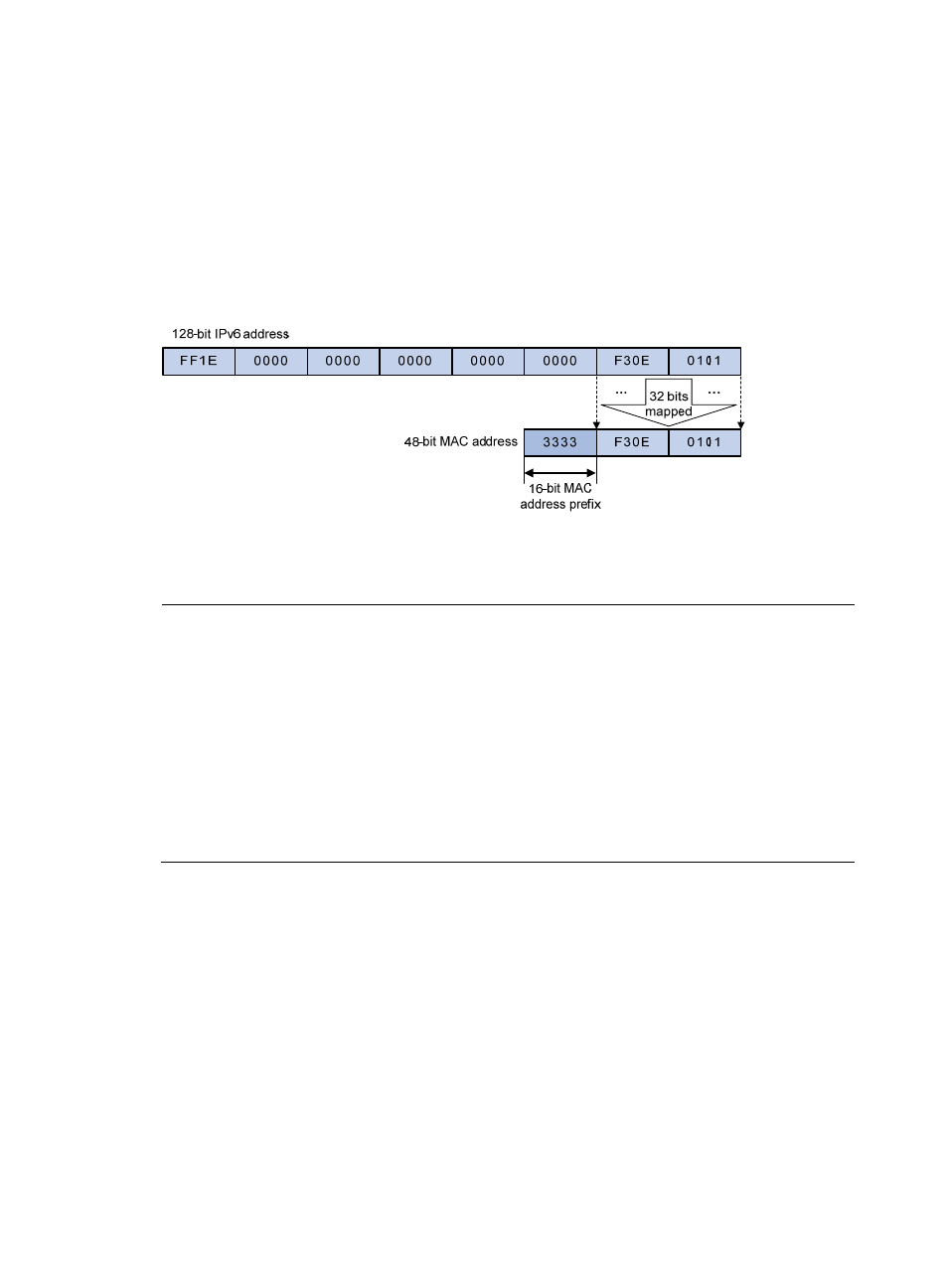
The most-significant 16 bits of an IPv6 multicast MAC address are 0x3333. The least-significant 32 bits
are the least-significant 32 bits of a multicast IPv6 address.
Figure 7 An example of IPv6-to-MAC address mapping
Multicast protocols
NOTE:
•
Generally,
Layer 3 multicast refers to IP multicast working at the network layer. The related multicast
protocols are Layer 3 multicast protocols, which include IGMP/MLD, PIM/IPv6 PIM, MSDP, and
MBGP/IPv6 MBGP.
Layer 2 multicast refers to IP multicast working at the data link layer. The related
multicast protocols are Layer 2 multicast protocols, which include IGMP snooping/MLD snooping, and
multicast VLAN/IPv6 multicast VLAN.
•
IGMP snooping, IGMP, multicast VLAN, PIM, MSDP, and MBGP are for IPv4, MLD snooping, MLD, IPv6
multicast VLAN, IPv6 PIM, and IPv6 MBGP are for IPv6.
•
This section provides only general descriptions about applications and functions of the Layer 2 and
Layer 3 multicast protocols in a network. For more information about these protocols, see related
chapters.
Layer 3 multicast protocols
Layer 3 multicast protocols include multicast group management protocols and multicast routing
protocols.