Saving images to a connected computer, 5 – 8 in “using wps-compatible access, Points” (= 142) – Canon PowerShot G3 X User Manual
Page 142
142
Setting Menu
Accessories
Appendix
Index
Before Use
Basic Guide
Advanced Guide
Camera Basics
Auto Mode /
Hybrid Auto Mode
Other Shooting Modes
P Mode
Tv, Av, M, C1, and C2 Mode
Playback Mode
Wi-Fi Functions
●
For information on WPS compatibility and for instructions on
checking settings, refer to the access point user manual.
●
A router is a device that creates a network (LAN) structure for
connecting multiple computers. A router that contains an internal
Wi-Fi function is called a “Wi-Fi router”.
●
This guide refers to all Wi-Fi routers and base stations as “access
points”.
●
If you use MAC address filtering on your Wi-Fi network, be sure
to add the camera’s MAC address to your access point. You can
check your camera’s MAC address by choosing MENU (= 31)
► [ 4] tab ► [Wi-Fi Settings] ► [Check MAC Address].
Using WPS-Compatible Access Points
WPS makes it easy to complete settings when connecting devices over
Wi-Fi. You can use either Push Button Configuration Method or PIN
Method for settings on a WPS supported device.
1
Confirm that the computer is
connected to an access point.
z
For instructions on checking the
connection, refer to the device and
access point user manuals.
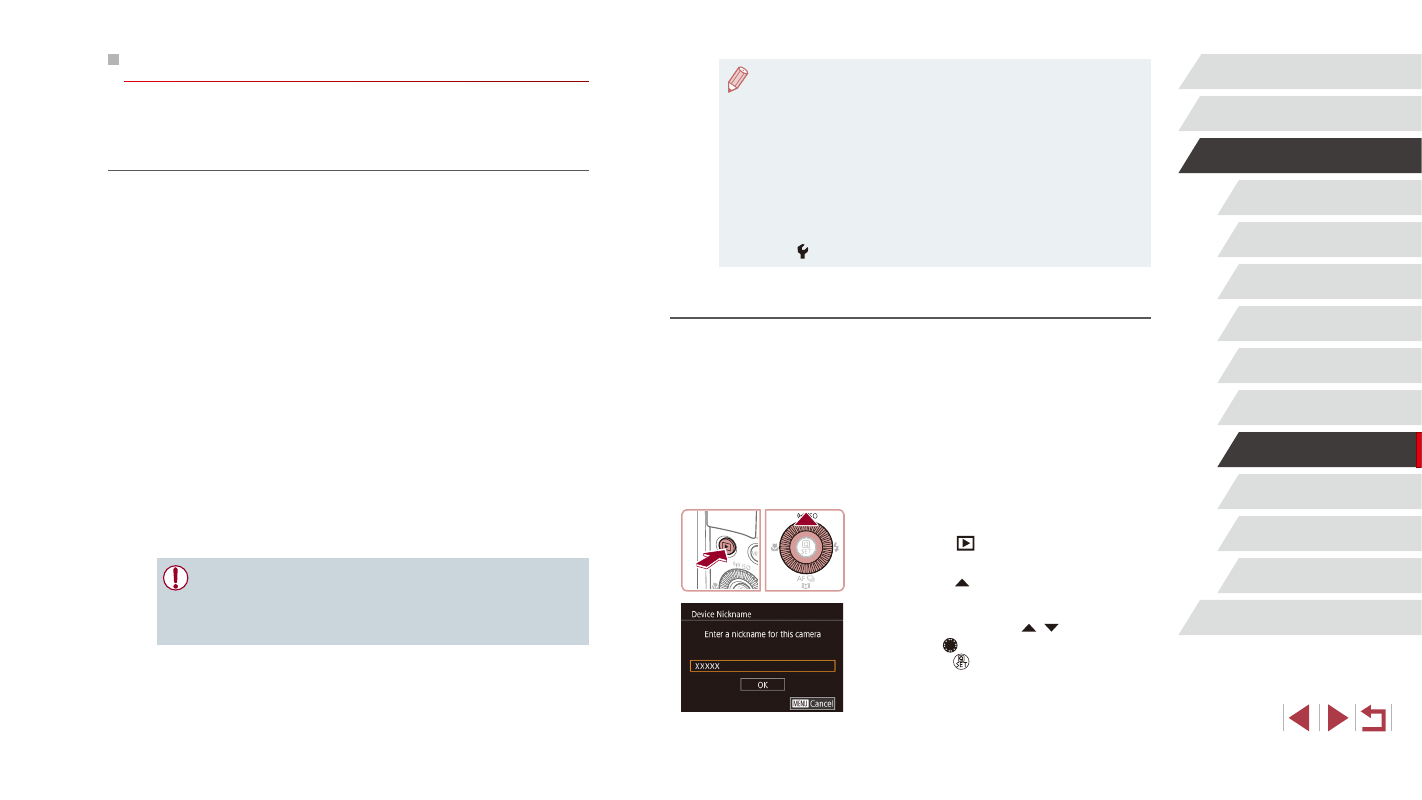
2
Access the Wi-Fi menu.
z
Press the [
] button to turn the camera
on.
z
Press the [ ] button.
z
If the [Device Nickname] screen is
displayed, press the [ ][ ] buttons or
turn the [ ] dial to choose [OK], and then
press the [ ] button.
Saving Images to a Connected Computer
Connect to your access point via Wi-Fi as follows.
Also refer to the access point user manual.
Confirming Access Point Compatibility
Confirm that the Wi-Fi router or base station conforms to the Wi-Fi
Connection methods vary depending on whether the access point
supports Wi-Fi Protected Setup (WPS, = 142) or not (= 144). For
non-WPS access points, check the following information.
●
Network name (SSID/ESSID)
The SSID or ESSID for the access point you use. Also called the
“access point name” or “network name”.
●
Network authentication / data encryption (encryption method /
encryption mode)
The method for encrypting data during wireless transmission. Check
which security setting is used: WPA2-PSK (AES), WPA2-PSK
(TKIP), WPA-PSK (AES), WPA-PSK (TKIP), WEP (open system
authentication), or no security.
●
Password (encryption key / network key)
The key used when encrypting data during wireless transmission. Also
called the “encryption key” or “network key”.
●
Key index (transmit key)
The key set when WEP is used for network authentication / data
encryption. Use “1” as the setting.
●
If system administrator status is needed to adjust network
settings, contact the system administrator for details.
●
These settings are very important for network security. Exercise
adequate caution when changing these settings.