Available algorithms, Distortion, Pre amplification – D16 Group Drumazon 2 Drum Machine 909 Emulation Plug-In User Manual
Page 16: Crossover
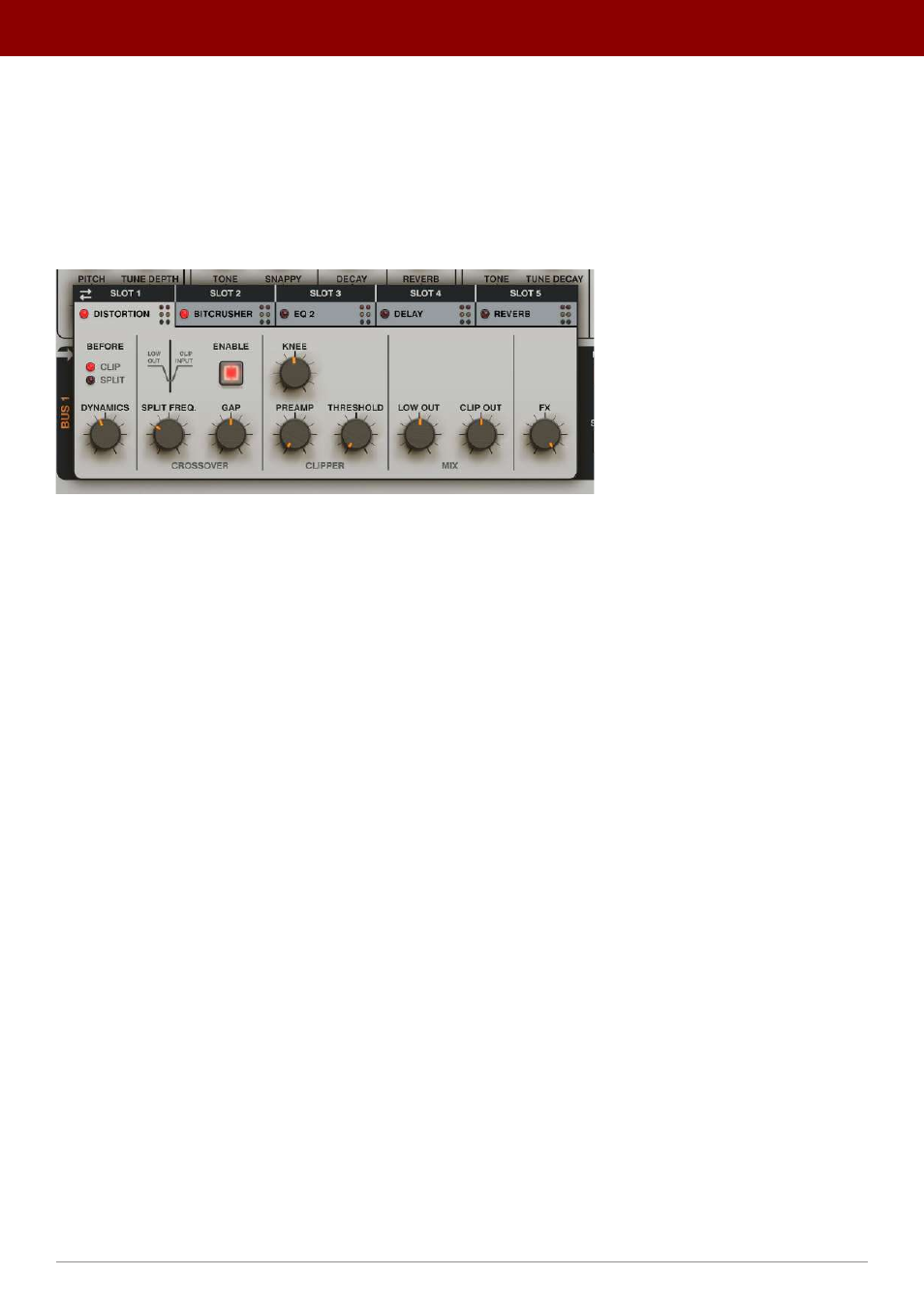
Available algorithms
There are
10 effect
instances available in total (
5
per
Bus
), but only
8 different algorithms
since there are some dupli-
cates for more commonly used ones (
EQ
and
Dynamics
).
Distortion
The
Distortion
is an emulated diode-clipper style distortion effect with pre compression and optional crossover.
The Distortion effect
The following parameters are available:
Pre amplification
•
Dynamics
- (Single-knob compressor) Turn clockwise to increase the amount of compression for the input signal
prior to clipping.
•
Before
- Decides where the compressor is located in the signal flow. This makes a difference only when
Crossover
is active. If
Crossover
is disabled, this parameter does nothing and compression is performed before clipping;
•
Clip
- Compression is done after the signal is divided into two bands and applied only on the higher band
(the
Clipper’s
input) and before clipping.
•
Split
- Compression is applied before the signal is split into two bands, so affects
Higher
and
Lower
bands.
Crossover
•
Enable
- Enables the 2-way
Crossover
. When activated, the signal is split into two separate frequency bands;
Lower
, which bypasses the
Clipper
and goes directly to the
Distortion’s
output.
Higher
, which goes into the
Clipper
, so only higher tones are distorted while lower frequencies remain intact. If
Crossover
is disabled then
other parameters from this section remain inactive.
•
Split Freq.
- Decides the frequency where the signal is divided into two bands.
•
Gap
- Sets the gap between
Lower
and
Higher
bands;
•
If the
Gap
= 0
then the two bands are conjoined.
•
If the
Gap > 0
then the bands are disjoint and there’s a gap between
Lower
and
Higher
bands; the bigger
the value, the greater the gap (expressed in
Octaves
).
•
If the
Gap < 0
then the bands overlap. The lower the value, the bigger the common part of the bands
(expressed in negative
Octaves
).
16
inteRface oveRview •
The sound conTrol secTion