Appendix – Areca ARC-8050T3U 6-Bay Thunder3 Desktop RAID Storage Array User Manual
Page 147
147
APPENDIX
RAID set. Then, data on the existing volume sets (residing on
the newly expanded RAID set) is redistributed evenly across
all the disks. A contiguous block of unused capacity is made
available on the RAID set. The unused capacity can be used to
create additional volume sets.
A disk, to be added to a RAID set, must be in normal mode
(not failed), free (not spare, in a RAID set, or passed through
to host) and must have at least the same capacity as the
smallest disk capacity already in the RAID set.
Capacity expansion is only permitted to proceed if all vol-
umes on the RAID set are in the normal status. During the
expansion process, the volume sets being expanded can
be accessed by the host system. In addition, the volume
sets with RAID level 1, 10, 3, 5 or 6 are protected against
data loss in the event of disk failure(s). In the case of disk
failure, the volume set changes from “migrating” state to
“migrating+degraded“ state. When the expansion is complet-
ed, the volume set would then transition to “degraded” mode.
If a global hot spare is present, then it further changes to the
“rebuilding” state.
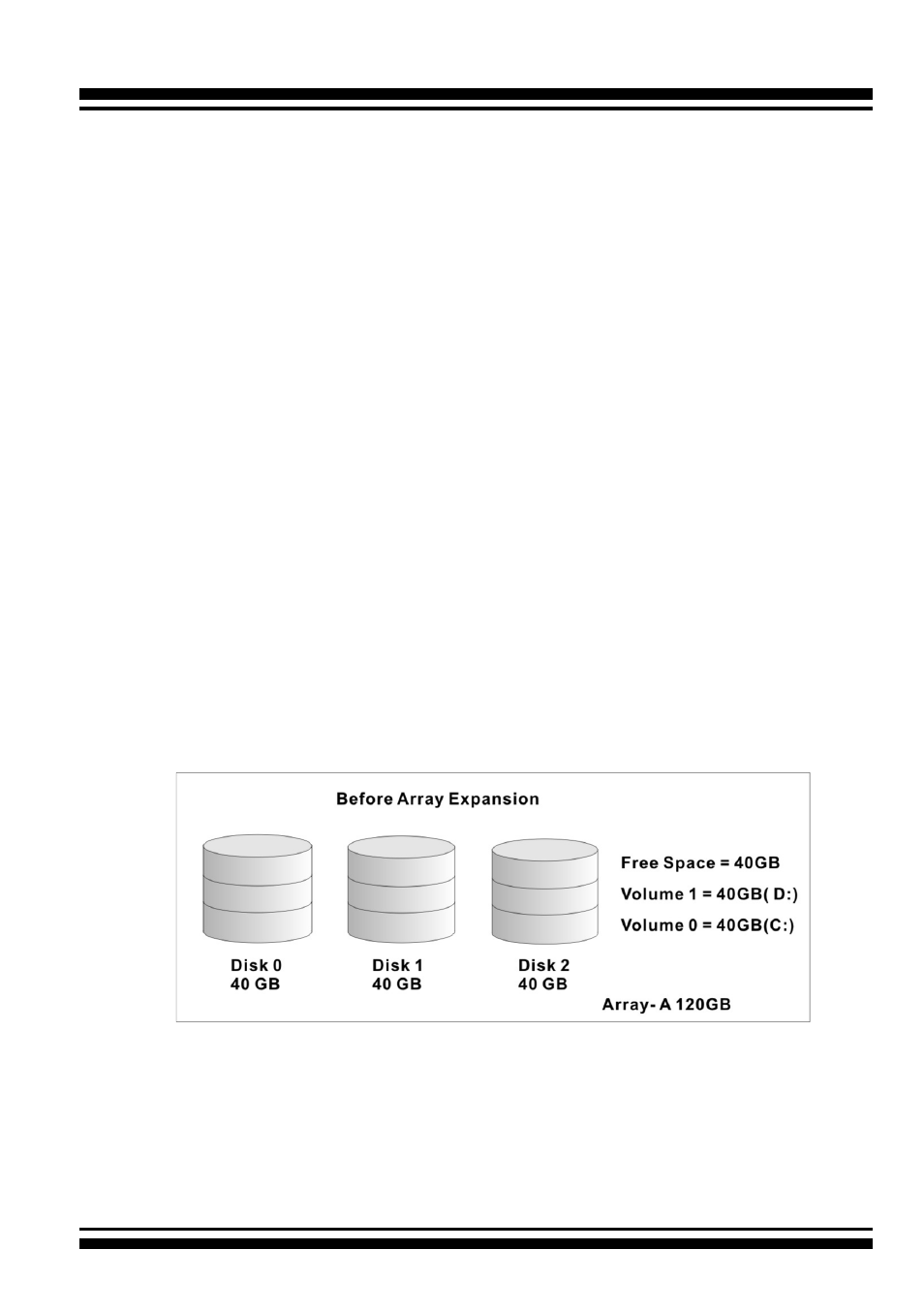
The expansion process is illustrated as following figure.
RAID controller redistributes the original volume set over the
original and newly added disks, using the same fault-tolerance
configuration. The unused capacity on the expand RAID set
can then be used to create an additional volume set, with a
different fault tolerance setting (if required by the user.)